
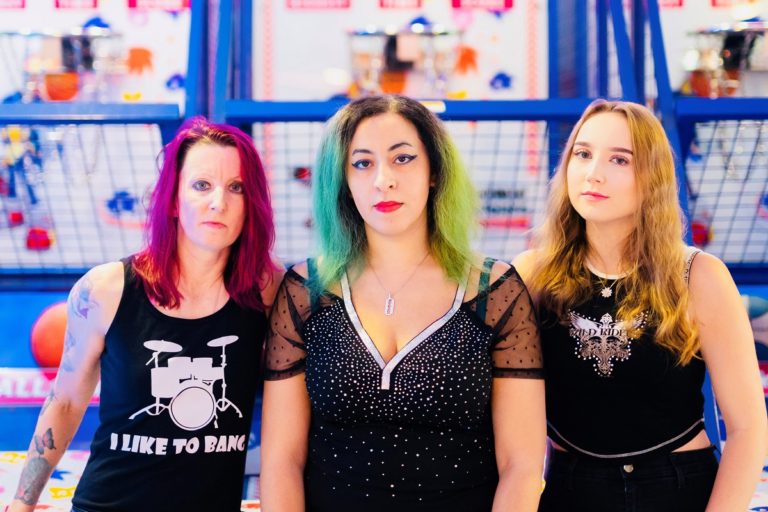

The last 18 months have been a whirlwind for The Kut. Having scored a number one album in the UK Rock Albums Chart with their second album, Grit, they’ve also wowed arena crowds with Electric Six, and have recently blazed a trail across the UK as support to Shonen Knife. Devolution Magazine recently spoke with vocalist/songwriter/multi-instrumentalist Princess Maha prior to the band’s recent gig at Bedford Esquires.
What are your earliest musical memories? What fired up your interest in music?
Growing up there was always music in the house. We’d always sing along to the Beatles, or the biggest tracks of the time. My mum had a piano in the house, and I’d always play on it.
Who inspired you to pick up a guitar?
I don’t know. I tried out a lot of instruments, I played the violin, the clarinet, the drums, and I liked them, but I didn’t really connect with them. I thought they were great instruments but they didn’t really accompany the vocals I was doing, and the songs that I was writing. My sister and her then boyfriend, had a guitar and a bass, and once she left home this guitar was just hanging around, I picked it up one day, and discovered that it was I was looking for to accompany the vocals. I was always into guitar bands, The Stone Roses, The Smiths. Picking up the guitar was more a product of what I was listening to and the people around. Growing up in Blackpool there was two groups; indie and rock, but I kind of liked both, and I’d dip in and out of both groups. But once I found the guitar, I’d play it until my fingers bled, and then a bit more.
Did you feel isolated growing up in Blackpool, and did that help you form a unique style?
The first band I ever saw live were James, they stayed at my parent’s hotel, my sister was a massive fan and reached out to them when they were on tour. Then I didn’t see many bands until festivals came along. Not that many bands passed through Blackpool, though it’s a lot better now.
Last year you released your sophomore album, Grit. How do you feel about it now it’s been out in the world for a while?
It’s been amazing, especially with it doing so well. I loved it anyway, but now it feels like a breakthrough album for us. We’d been playing some of those songs around the first time we were touring the first album, so the album had already been developing, so when we got the funding [from The Arts Council] we were able to add in some more, so some of those songs were part of the journey as well. It’s been great touring it, the reaction live has been even more satisfying than the chart placing.
Do you feel playing the songs live adds an extra dimension to them?
I guess there’s two types of band. There’s the band who is better on record, and there are bands who are better live. I love the records, they sound great, but I’m not sure if they catch that full feisty live vibe. When we play live, it’s not as if we just stand around and you might as well listen to the CD, when people come to our gigs, we want them to feel the energy that we feel.
You wrote and played most of the instruments on the record. As an artist, how do you exercise editorial control on your own work?
I guess it is a fine art. Working with a producer to record it, really helped in that respect. When I used to record and produce stuff myself, even though I’ve produced other artists, I did keep changing bits, and it would just be an endless process where it would never be done. Working with someone who does have finite time, schedule (and budget!) can say ‘That’s done, let’s move on’.
How does Grit slot into your discography? Is it part of the creative cure, or have you gone off on a new tangent?
I don’t really see too much difference between the two albums, but I’ve been told there is one. I feel like it’s an extension of the same body of work that’s developing and becoming more of its own entity.
Grit has garnered praise from both the mainstream and alternative press. To what do you attribute its crossover appeal?
I guess we fall into the middle ground where we’ve got elements that are influenced by rock and metal, that’s the stuff I always listen to, but there’s also a more pop/rock influence, the kind of bands that would have got you into rock. On [debut album] Valley Of Thorns there was probably more metal influences, and elements of frustration, but I don’t think we’ve moved away from that on Grit.
Although you had a little funding from The Arts Council, how easy is it to survive as an independent artist?
It’s almost impossible. There is this movement towards the idea of a “broken record”, how the industry needs to work together to fix streaming, and to support live acts. We’re in a fortunate position where we go out, get paid for shows and sell merch, and we can survive that way. I’d say it’s very difficult for independent artists, it’s not impossible but you couldn’t do it if you didn’t love it. It is very hard, and I’m not going to pretend it is not.
By the same token, how is it surviving as a female artist? Obviously, you have a lot more pressures than men would have. It still feels like a male dominated industry.
I feel like there’s definitely a divide. If you look at some of the festival line-ups, you’ll see that if you take out the male performers, they’ll be virtually empty. But that’s just the tip of the iceberg. What we should be looking at as an industry is how many management companies are supporting female artists, what about the independent labels, what about the major labels? If we’re all happy to support female artists who look like Barbie and Mariah Carey, that’s great, but if we’re talking about female instrumentalists, producers…tonight we’ve got a female engineer, which is brilliant, but it is so rare. What we’d want ideally, is that female and male musicians are recognised equally, and it shouldn’t be about gender. There was a figure that said 13% of festival headliners had female members, which I found shocking. Luckily, for us we’re breaking through at this point, but how long would it take for us to become festival headliners? And could it have happened five years ago? It’s not that there aren’t female musicians out there, it’s that when they exist, they’re not supported the same way through management, signing, funding, and that’s why many female artist don’t appear on the festival bills.
That’s why your dates with Shonen Knife have been so great. It’s an all-female line-up.
It’s been amazing. If it wasn’t for bands like Shonen Knife, it’d be even more difficult for female bands to exist today. So, what they are doing is amazing. They’re incredible. Their songs are great, they’re lovely to work with, and it has just been a pleasure to be out with them. And you know that the people in the crowd have already got over the sexism thing, they wouldn’t be here if they hadn’t got over those things. If we’re out here filling venues every night, and we are an all-girl bill then why can’t festivals have more female artists?
It seems that things are slowly changing, and just by the dint of being a female band, do you think you are helping to know walls down?
I’d like to think so. When The Kut started as a project, we’d turn up at venues and people would be like “Are you girlfriends of the band?”, and I’ve genuinely had someone, who is a fan (and very lovely), looking for the male guitarist who was playing my solos, and had to come for a second time to believe that there wasn’t another guitarist. We’ve spent over a decade on the road, and I hope that the things that were happening then aren’t happening now. Change is definitely coming.
Years ago, women in rock and metal had to conform to a fluffy stereotype, so it was great when a band like L7 came along to blow it all away.
L7 have a good vibe. The thing is we don’t need to be pigeonholed in these ways, I’m definitely not going to turn up in a bikini and perform, that’s not what I’m about. Women have fought for a very long time so we don’t have to take our clothes off to sell what we do. I’m a developing artist, and to keep on evolving is all that matters to me, sometimes we do dress up for videos, but that’s not all there is to it. We’re musicians and we’ve worked hard over many years, and I hope that when people come to the shows or hear the record, they can open their ears to that.
Grit was so well-received that it’s going to be a difficult album to follow up. Have you started thinking about it yet?
Well, I write songs all the time. The thing is, with Grit doing so well, there’s no hurry for us to release another album. I’ve got a Patreon site, and I’m happy to share demos on there and see what the consensus is. Last year one of the Team Raisers gave me a grand piano, which now lives in our studio, and it totally blew me away. So, I’ll probably write some songs on the piano as homage to that wonderful gift and put them on Patreon to see what people think. Nothing is set in stone about a new record, and I don’t want to make promises I can’t keep, but I’m not ruling it out either.
What are the rest of your plans for 2023?
This tour is coming to an end, which is such a shame because it has been amazing, if we could keep going then I’d love to. We’ll get home and have a bit of a reframe, then we’ve got a new single coming up in June. I run Criminal Records, and there’s a few releases coming up, so taking care of the roster. I did stop the record label for a while because I felt like it was side lining The Kut, but now I feel like I’ve found a way to do both, it’s all about having the right people around.
Interview by Peter Dennis